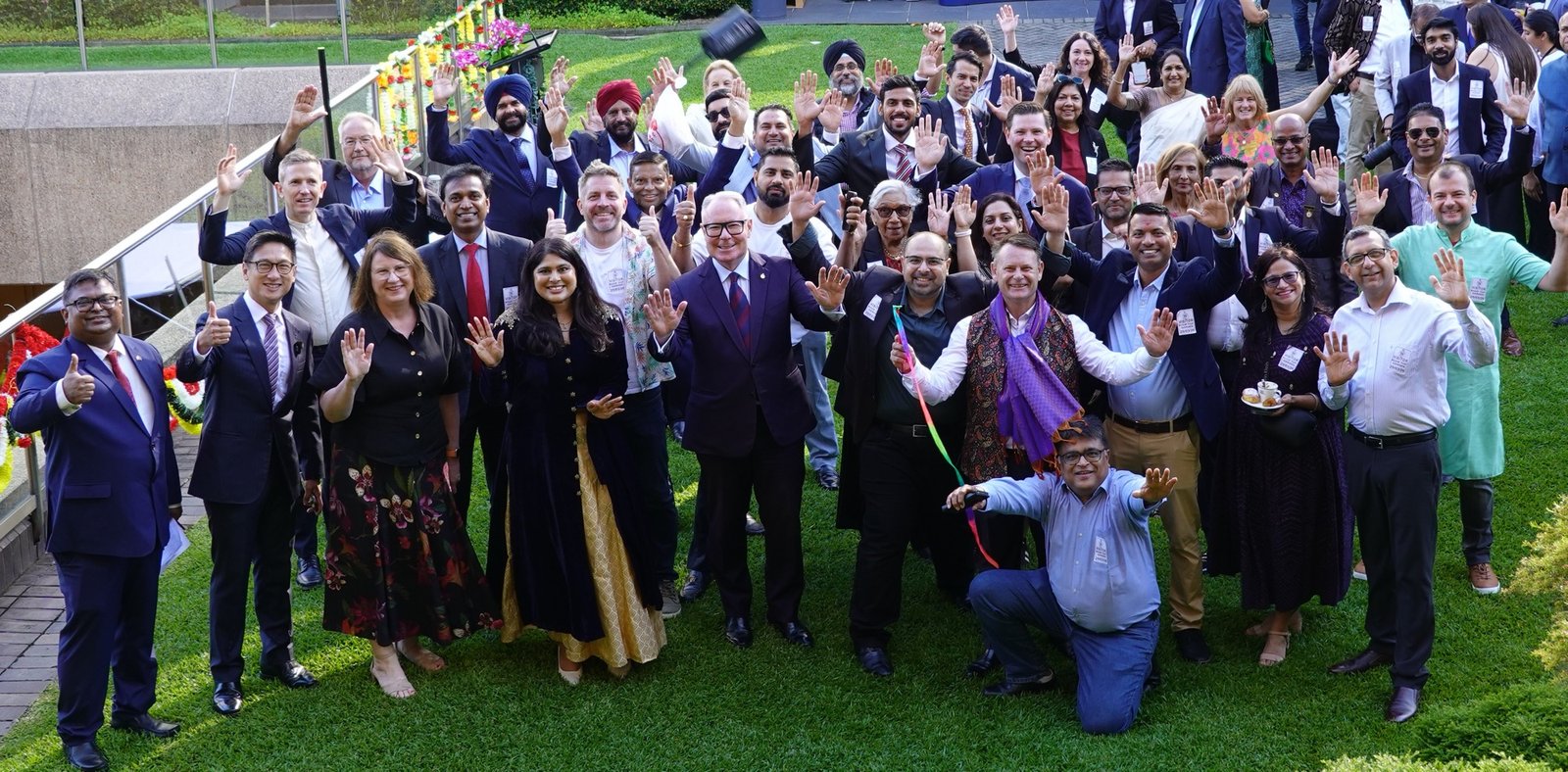
On a cool November evening in 2014, thousands of Indian Australians filled Melbourne’s Rod Laver Arena, waving flags, taking photographs and witnessing something many believed they would never see in their lifetime.
An Indian Prime Minister addressing the Australian Indian community with a confidence and visibility that reflected a changing India.
For some, it was a political moment.
For many others, it was personal.
Students who had arrived in Australia with two suitcases and a dream stood alongside business owners, taxi drivers, doctors, engineers, academics and young Australians born thousands of kilometres from India but deeply connected to its culture.
Looking back, that evening would come to symbolise more than a diplomatic visit.
It marked the beginning of a new chapter in Australia–India relations.
Now, as Prime Minister Narendra Modi is expected to return to Australia in July 2026, the relationship between the two countries bears little resemblance to what it was twelve years ago.
Australia has changed.
India has changed.
And perhaps most significantly, the Indian Australian community has changed.
The story of those twelve years is not simply the story of a political leader. It is the story of two nations discovering just how important they are to one another.
It is also the story of a diaspora that became one of the strongest bridges connecting them.
A Relationship Once Defined by Potential
For decades, diplomats described Australia and India in remarkably similar terms.
Both were democracies.
Both were members of the Commonwealth.
Both spoke English.
Both shared strong legal and institutional traditions.
Yet despite these similarities, the relationship rarely matched its potential.
Trade remained relatively modest.
Political engagement was intermittent.
Strategic cooperation was limited.
Even as India emerged as one of the world’s fastest-growing economies, many Australians still viewed the country through an outdated lens.
Likewise, Australia often occupied a relatively small space in India’s foreign policy imagination.
The foundations existed.
The momentum did not.
That began to change after 2014.
Over the following decade, Australia and India steadily moved from viewing each other as opportunities to viewing each other as partners.
Today, the relationship is routinely described by officials in both countries as one of the most important strategic partnerships in the Indo-Pacific region.
Such language would have seemed ambitious only a generation ago.
Now it has become mainstream.
The Diaspora That Changed the Conversation
Diplomatic agreements often make headlines.
Communities create lasting change.
No discussion about Australia–India relations can be complete without recognising the extraordinary rise of the Indian Australian community.
According to recent population estimates, Australians of Indian heritage now number more than one million people, making them one of the nation’s fastest-growing and most influential communities.
The impact can be seen everywhere.
Indian Australians lead ASX-listed companies.
They work in hospitals, schools and universities.
They serve in local councils and state parliaments.
They operate small businesses that have become pillars of local communities.
They are helping shape modern Australia.
Over the past decade, publications such as Indians in Sydney have documented this transformation firsthand.
The stories have often been remarkably similar.
A student arrives with uncertainty.
A family takes a risk.
A migrant builds a business.
A young professional rises through the ranks.
A community volunteer creates lasting impact.
Individually, these stories may seem ordinary.
Collectively, they tell the story of one of the most successful migration journeys in modern Australian history.
Beyond Cricket and Curry
There was a time when many Australians associated India primarily with cricket, Bollywood and cuisine.
While those cultural connections remain important, the relationship today extends far beyond them.
Australia increasingly sees India as a critical economic and strategic partner.
India increasingly views Australia as a trusted democratic ally in a rapidly changing world.
Trade has expanded significantly.
Cooperation in education, critical minerals, renewable energy, defence and technology continues to grow.
The Australia–India Economic Cooperation and Trade Agreement marked one of the most important milestones in the modern relationship, creating new opportunities for businesses and investors in both countries.
Universities are strengthening research partnerships.
Technology firms are building cross-border collaborations.
Start-ups are finding opportunities in both markets.
The scale of engagement would have been difficult to imagine only a decade ago.
Why Modi’s 2026 Visit Matters
Every prime ministerial visit carries symbolism.
This one carries history.
If the expected July 2026 visit proceeds as planned, Narendra Modi will return to an Australia that has undergone profound change.
He will return to a country where the Indian community has become an essential part of the national story.
He will return to a relationship that is stronger than at any previous point in history.
And he will return at a time when Australia and India are increasingly looking towards one another to address shared challenges and opportunities.
The significance of the visit extends beyond official meetings and diplomatic announcements.
For many Indian Australians, it will be a reminder of how far the community has travelled.
For younger generations, it may serve as confirmation that their dual identity is not a contradiction but a strength.
For business leaders, it represents an opportunity to deepen economic ties.
For governments, it reinforces the importance of a partnership likely to shape the coming decades.
The Sydney Story
Perhaps nowhere is this transformation more visible than Sydney.
Home to one of Australia’s largest Indian communities, Sydney has become a living example of the Australia–India relationship in action.
Walk through Parramatta, Harris Park, Wentworthville, Blacktown or Norwest and you will find businesses, cultural institutions and community organisations helping shape the city’s future.
Indian entrepreneurs are creating jobs.
Students are building careers.
Community organisations are supporting new arrivals.
Families are establishing roots that will last generations.
For Indians in Sydney, these stories are not statistics.
They are neighbours.
Friends.
Colleagues.
Family members.
Over the years, our publication has had the privilege of sharing countless stories of achievement, resilience and contribution.
Together, they form a portrait of a community that has become an indispensable part of Australia’s multicultural success story.
Looking Beyond Politics
History often focuses on leaders.
Yet the true measure of a relationship lies in its people.
Long after political speeches have ended and official delegations have departed, the Australia–India story will continue to be written by ordinary individuals.
By the student arriving at Sydney Airport for the first time.
By the entrepreneur opening a new business.
By the researcher developing a breakthrough innovation.
By the family creating a home between two cultures.
These are the people who have transformed a diplomatic relationship into a human one.
As Australia prepares to welcome Narendra Modi once again, it is worth reflecting not only on how much the relationship has changed, but why it has changed.
The answer is not found solely in trade agreements or strategic partnerships.
It is found in people.
In the countless lives that connect Australia and India every single day.
Twelve years ago, the relationship was defined by potential.
Today, it is defined by partnership.
And the next chapter is only just beginning.