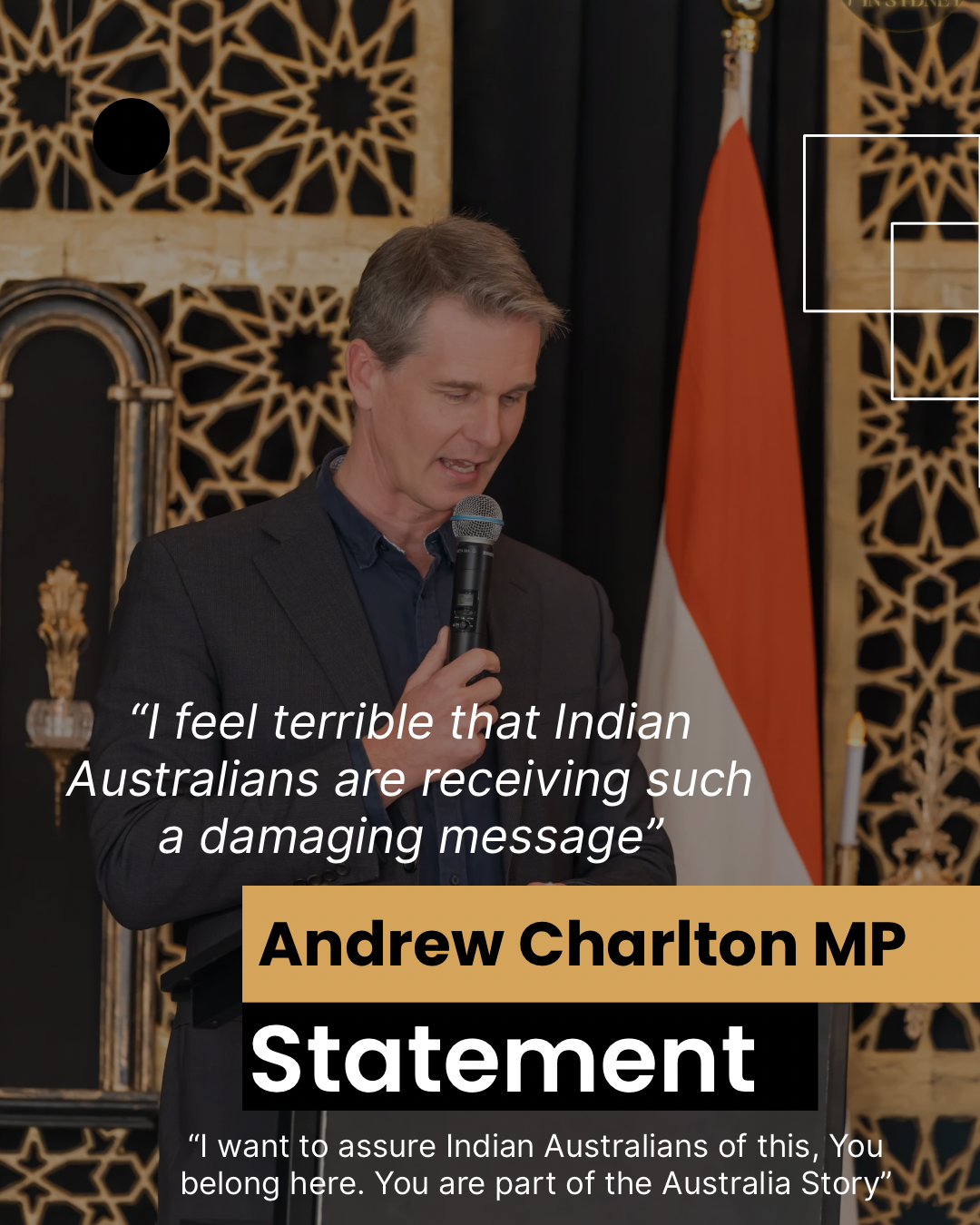
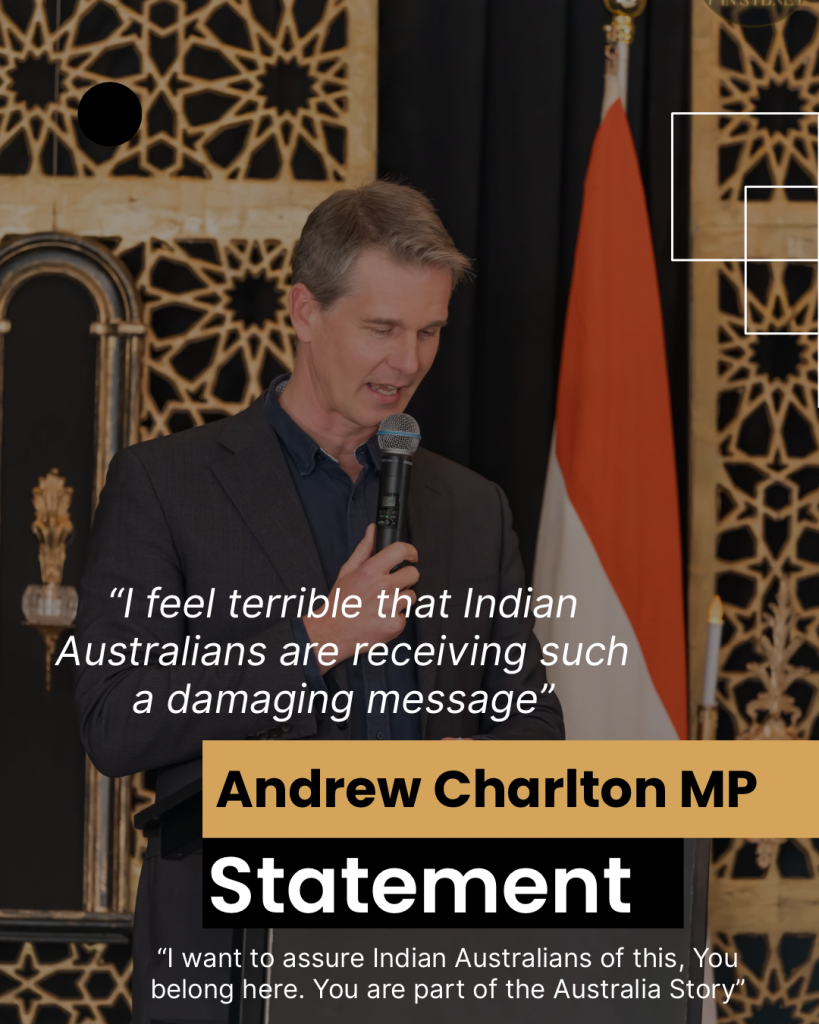
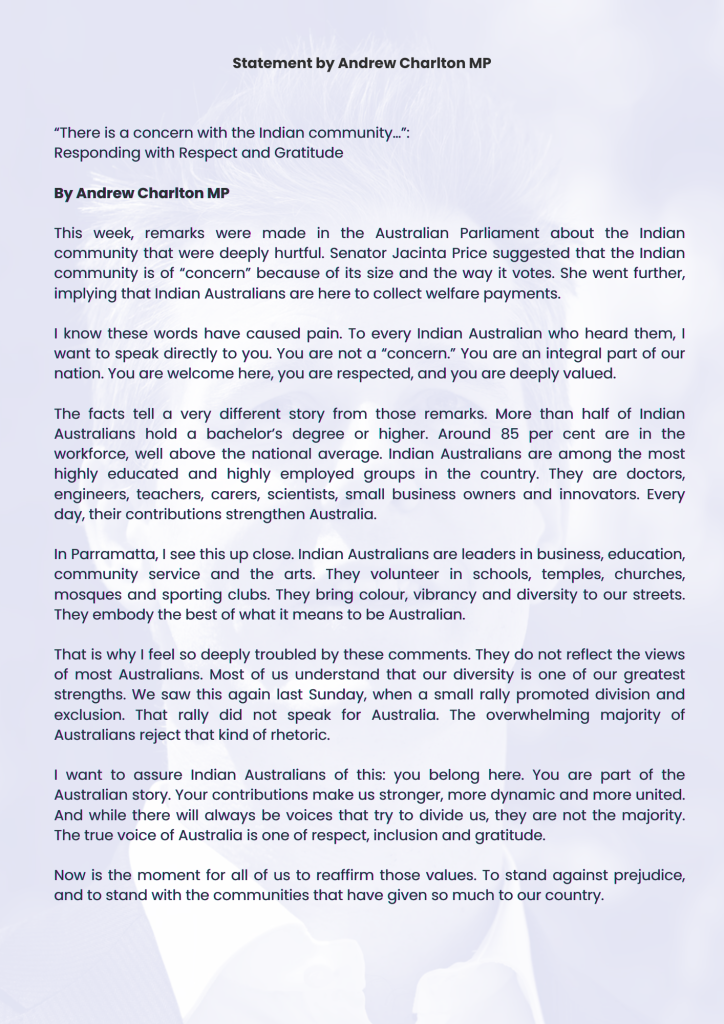
When a community is singled out in the national parliament as a “concern,” words can wound far beyond the chamber walls. This week, Dr Andrew Charlton MP answered that moment with something rarer in political life: moral clarity. In a statement addressed directly to Indian-Australians, Charlton said, unequivocally, “You are not a ‘concern.’ You are an integral part of our nation… welcome here, respected, and deeply valued.” It was more than a rebuttal – it was a standard. It articulated the Australia most of us recognise: confident, plural, and grateful to the people who build it every day.
Dr Charlton’s response did not appear in a vacuum. It came after a fresh round of controversy in Canberra, where the politics of migration and identity once again grabbed headlines. Live coverage this week tracked the fallout from comments and rallies that targeted migrants broadly and, in the discourse that followed, Indian-Australians specifically. Leaders across the spectrum condemned the divisive rhetoric, and the government warned against fuelling extremism around the anti-immigration marches held on 31 August.
The Facts Behind the Feeling
Dr Charlton’s statement worked because it married empathy with evidence. The data is emphatic: Indian-Australians are among the most educated and most employed communities in the country. A comprehensive Department of Foreign Affairs and Trade (DFAT) statistical snapshot released in July–August 2025 confirms that 68% of Indian-born migrants hold a bachelor’s degree or higher, and their labour-force participation rate sits at 85% (with an employment rate of 80.3%) — figures above migrant averages and far above the broader Australian average for tertiary attainment.
The same analysis charts the rise and vibrancy of the diaspora: roughly 988,270 Australians traced Indian heritage at the 2021 Census, a 3.7-fold jump since 2006, with continued growth since then. It notes strong business creation (up from 30,000 Indian-Australian-owned businesses in 2016 to 50,000 in 2021) and a distinctive concentration in professional sectors – all of which align with what communities in Parramatta, Harris Park, and beyond live every day.
These statistics are not cold comforts; they are the backbone of Dr Charlton’s argument. They refute caricature. They show a community that is studying, working, hiring, volunteering, and leading – an engine of Australian prosperity and a cultural wellspring.
Leadership That’s Local — and Lived
Dr Charlton’s words matter because they’re backed by an unusually consistent record of engagement. In Parramatta, he is not a fair-weather friend who drops in at festivals; he is a builder. In April this year, Dr Charlton announced a $7 million election commitment for a new, two-storey, multi-purpose community hall at the Sri Murugan Temple in Mays Hill – a tangible investment that will deliver an 800-seat hall, learning rooms, a library, and meeting spaces for the broader community. This is infrastructure for belonging, not just for celebration.
That pattern of practical support is why civil society has noticed. The Hindu Council of Australia publicly recognised Dr Charlton’s “significant contributions” and his “sincere commitment to our community’s evolving needs,” citing his advocacy for stronger Australia–India ties – including authoring Australia’s Pivot to India. Independent community outlets have called him a “champion” for the Hindu community, praising his habit of listening first and acting with follow-through.
Look closer at Harris Park – the heart of “Little India.” Dr Charlton has backed the community campaign to deliver the long-promised Welcome/India Gate, urging the City of Parramatta to honour its commitment rather than replace it with a token alternative. Symbols matter because they tell newcomers and old neighbours alike who we are. Charlton understands that.
Bipartisan Voices Against Scapegoating
While politics can be sharp-edged, it would be unfair to paint the defence of Indian-Australians as a purely partisan stance. In the wake of last weekend’s anti-immigration rallies, senior ministers condemned rhetoric that targets migrants by origin, with warnings about social cohesion and safety. And notably, Liberal Senator Paul Scarr, the Shadow Minister for Immigration and Multicultural Affairs, denounced “vile” anti-migration pamphlets aimed at Indian communities, saying the Indian diaspora is a “blessing” for Australia. That matters: it shows that, even in a heated season, there remains bipartisan space to call out hate and stand with migrants.
Foreign Minister Penny Wong has repeatedly cast the Indian-Australian community as a pillar of the bilateral relationship and of Australia’s own future. In speeches around the Australia–India Leadership Dialogue, she highlighted the “dynamic Indian-Australian community, our fastest growing diaspora,” and the people-to-people ties that power trade, education, and innovation. The official line from government portfolios that matter — foreign affairs, trade, multiculturalism — is clear: Indian-Australians are part of the solution to our economic and strategic challenges, not a “concern” to be managed.
The Stakes: Social Cohesion in a Volatile Moment
Australia is navigating an age of sharper rhetoric, algorithmic outrage, and imported polarisation. Authorities and former extremists warned this week about how divisive narratives can be weaponised, particularly in the context of anti-immigration protests. Leaders cautioned against normalising language that sets neighbour against neighbour — because it is a short road from coded slur to open menace.
It is in that context that Dr Charlton’s words cut through: they re-centred the national conversation on gratitude and facts. He did not minimise pain; he named it. He did not counter one stereotype with another; he described the daily reality he sees in Parramatta – doctors and engineers, teachers and carers, small business owners and innovators, volunteers across temples, churches, mosques and sporting clubs – and affirmed their belonging. That is what responsible leadership sounds like in a multicultural democracy.

A Long Track Record with India – and with Indians in Australia
Dr Charlton’s advocacy is not limited to domestic community issues. He has spent years arguing that Australia must invest in a deeper economic and strategic partnership with India – not as a slogan, but as a practical agenda. His book, Australia’s Pivot to India, launched by the Prime Minister in Parramatta in 2023, mapped a future where education, technology, defence-adjacency and diaspora entrepreneurship knit our countries closer together.
That agenda is now mainstream. Government initiatives like the Maitri scholarships and grants are expanding two-way talent and research, and Quad cooperation is bringing India and Australia into tighter strategic alignment. The diaspora is the bridge that makes all of that real — the “human bridge,” as Charlton has called it.
What Leadership Looks Like
There are different kinds of political actors. Some chase the heat of the daily news cycle; others quietly do the work that outlasts a headline. With Indian-Australians, Dr Charlton is in the second camp. He shows up at the school prize-giving and the temple fundraiser – but also in the budget line items and the council submissions. He stands up when it would be easier to stay quiet, and he backs it with policy and projects when the cameras have gone.
That’s why his statement this week deserves to be read as more than a rebuttal. It is a call to a better politics:
Lead with respect. When communities are targeted, the first duty is to reassure, not to triangulate. Bring receipts. Facts win the long game. The DFAT snapshot makes it impossible to sustain tropes about “welfare seekers” or “block votes” detached from economic reality. Invest in belonging. Buildings, grants, scholarships, and cultural markers like the India Gate matter. They turn warm words into civic architecture. Keep it bipartisan where you can. When leaders from different parties praise the Indian diaspora and reject scapegoating, it denies oxygen to fringe narratives.
The Community We Already Are
It is worth naming, too, what the Indian-Australian presence has already made possible. From Parramatta’s tech startups and accounting firms to the nurses who kept hospitals running, from the classical arts schools that keep languages alive to the Westmead researchers who push frontiers in medicine — Indian-Australians are not a future promise; they are a present fact.
When a politician recognises that with uncomplicated gratitude, it strengthens all of us. “You belong here,” Dr Charlton told Indian-Australians. “You are part of the Australian story.” That is the kind of sentence that steadies a country.

A Word on the Week – and the Way Forward
Yes, this has been a turbulent week in national politics. Coverage documented inflammatory set-pieces, and rhetoric around flags and identity again spilled into the Senate. But out in our suburbs, the more consequential story is quieter: a parent finishing a late shift; a student filing a visa extension and a job application; a volunteer coaching the under-12s on Saturday morning. That’s where Charlton’s statement lands – in ordinary lives that deserve security and respect after a bruising news cycle.
The path ahead is familiar. We have walked it before, through earlier waves of anxiety about Greeks and Italians, Vietnamese and Lebanese, Chinese and Sudanese Australians. Every time, the country we actually are has won out over the country some fear we might become. We did it by insisting on the best of our civic character: equal dignity, equal opportunity, and a stubborn refusal to let anyone be reduced to a talking point.
Dr Andrew Charlton did exactly that this week. He defended his neighbours with facts, affirmed their place with heart, and backed it with a record of delivery. In a political culture that too often rewards the loudest voice, his is a leadership style worth praising: steady, respectful, and anchored in community.
Indian-Australians are not a concern. They are a cornerstone. And with leaders like Dr Charlton standing up when it counts, the Australian story keeps getting better – smarter in its economy, stronger in its values, and richer in its people.