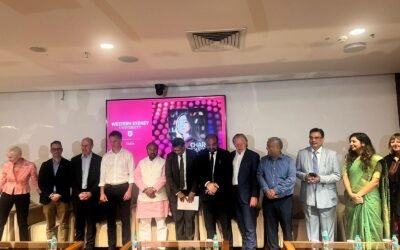
The scent hit us first – cardamom and saffron, cumin and coriander, the warm embrace of spices that had traveled across oceans and generations to fill the grand halls of Doltone House at Darling Island, Pyrmont. Then came the sound: the deep resonance of a didgeridoo’s opening notes during the Welcome to Country, the laughter of elders catching up in Punjabi, the excited chatter of teenagers switching between Hindi and Australian slang. And then, the sight that stopped us in our tracks: a sea of color—saris in emerald and gold, sherwanis in deep maroon, lehangas that shimmered like sunset on the Ganges—all moving together, all belonging, all home.
This was our Indians in Sydney Multicultural Gala 2026 – Friday, 21 August 2026, commemorating 79 years of India’s Independence. And it wasn’t just an event. It was a living, breathing testament to what happens when we as a community refuse to be defined by borders, by differences, by the quiet question of where do we belong?

The Night That Redefined Belonging
The first thing we noticed at our event wasn’t the grandeur—though there was plenty of that. Doltone House at Darling Island, Pyrmont was transformed into a jewel box of Indian culture, with gold drapes cascading from the ceiling, tables adorned with marigold garlands, and centerpieces that looked like they’d been plucked from a emperor’s garden. No, what stopped us was the feeling—the unmistakable sense that we had stepped into a space where everyone, regardless of where they came from or how long they’ve been here, was exactly where they were meant to be. Right in the front it was the Indian Taxi and London Taxi attracting the visitors from the wharf.. taking pictures.. enjoying the moment…without even being part of the Gala, even they become part of the gala
We watched as Premier Chris Minns walked through the doors, and something extraordinary happened. The room didn’t just notice his entrance. It breathed differently. Not because of his title, but because of what his presence represented: that the Indian community in New South Wales isn’t just tolerated—it’s celebrated. When he moved through the crowd, shaking hands and engaging with our guests, we saw the Premier lean in, really listen, as community members shared their stories. That moment—a leader truly hearing our community’s stories—was worth more than any speech.
And then there was former Prime Minister Scott Morrison, whose presence sent a different kind of ripple through the room. Here was a man who had led the nation, now standing among our community that had helped build it. The conversations he had with our elders—men and women who had built businesses, raised families, contributed to every aspect of Australian life—were filled with a quiet respect that spoke volumes.
But the moment that will stay with us forever came when Deputy High Commissioner Her Excellency Irina Thakur entered. The room seemed to glow. Here was someone who carried the weight of India-Australia relations on her shoulders, yet she moved through the crowd with the warmth of a beloved auntie. As she engaged with our community members, many of whom had tears in their eyes, we understood: this wasn’t just diplomacy. This was home recognizing home.
One particularly moving moment came when David Moncrieff MP took the stage to felicitate Mr. Rehmat Pasha, the beloved Bondi hero whose bravery and community service have made him a legend in Sydney’s eastern suburbs. The standing ovation he received spoke volumes about the respect and admiration our community holds for those who serve others with courage and humility.

What Multiculturalism Really Means (And What It Doesn’t)
We throw the word “multiculturalism” around like it’s a given, like it’s a box we’ve ticked as a society. But standing in that room, watching a Sikh grandfather teach his Australian-born grandson the steps to Bhangra while a group of Lebanese-Australian teenagers filmed it on their phones, we realized: multiculturalism isn’t a policy. It’s not a statistic. It’s a daily act of courage.
It’s the courage of the mother who sends her child to school with a lunchbox of roti and sabzi, knowing they might get teased—but doing it anyway, because this is who they are. It’s the courage of the father who corrects his Australian colleagues’ pronunciation of his name, not with frustration, but with patience, because he knows that every small correction is a step toward understanding. It’s the courage of our community that continues to celebrate its heritage, even when it feels like the world wants it to assimilate, to disappear, to be less.
And yet, multiculturalism isn’t just about courage. It’s about joy. The unabashed, unapologetic joy of being who we are. The joy of a room where Bollywood beats blend with Australian pop, where the scent of butter chicken mingles with the familiar comfort of a good old Aussie lamb chop, where a turban and a cowboy hat can exist in the same space without contradiction.
Donna Davis MP, representing the Minister for Multiculturalism, put it perfectly when she said, “We don’t lose our identity when we meet another culture. Sometimes, we finally understand it.” And that’s the truth of it. Multiculturalism isn’t about erasing differences. It’s about celebrating them. It’s about the magic that happens when a 70-year-old Indian grandmother and a 20-year-old Australian university student realize they both love the same Bollywood movie from 1975.

The Human Story Behind Cultural Identity
Our Indians in Sydney community is a tapestry of journeys—each one unique, each one powerful. There are those who arrived decades ago with little more than hope, who built businesses, raised families, and contributed to every aspect of Australian life. There are the second-generation Indian-Australians, born here, educated here, now shaping Australia’s future while honoring their heritage. And there are the newer arrivals, still finding their footing but already contributing their skills, their culture, their dreams to this nation.
This beautiful tension of cultural identity was on full display at our gala. The push and pull of where do we come from and where are we going, of who are we and who do we want to be. This is the reality of multiculturalism that no policy document can capture. It’s not just about maintaining traditions. It’s about creating new ones. It’s about our community members who now celebrate Australia Day with a barbecue and Diwali with fireworks. It’s about switching between Hindi and English mid-sentence, not because we’re confused, but because both languages are ours.
Jihad Dib MP, who understands this journey intimately, shared a story that brought the room to silence. He spoke about his father, who worked three jobs to give his children a better life, who insisted they learn Arabic at home but also perfect their English, who told them, “You are Lebanese. You are Australian. You are both. Never let anyone tell you different.” That’s the heart of multicultural identity—not either/or, but both/and.
When Cultures Meet: The Beauty and the Tension
Here’s what no one tells us about multiculturalism: it’s not always beautiful. Not at first. There are moments of misunderstanding, of frustration, of feeling like we’re constantly explaining ourselves, our culture, our right to exist as we are.
Andrew Charlton MP, who has thought deeply about Australia’s place in the world, spoke about India Australia eloquently. “The first generation bears the weight of the journey,” he said. “The second generation bears the weight of the question: Which world do I belong to? And the third generation? They’re the ones who get to answer: Both.” But that answer doesn’t come easily. It comes with the child who gets teased for their lunch. The teenager who gets asked, “But where are you really from?” The young professional who gets passed over for promotions because their name is “too hard to pronounce.”
And yet—and yet—there’s a moment when it all clicks. When the Australian-born child of Indian immigrants realizes that their ability to navigate two cultures isn’t a weakness, but a superpower. When the workplace that once saw diversity as a challenge realizes it’s their greatest strength. When the neighborhood that was once divided by language and tradition becomes united by shared experiences and mutual respect.
Senator Dave Sharma, who embodies the Indian-Australian experience, put it this way: “We spend so much time talking about the challenges of multiculturalism that we forget to celebrate its greatest gift—the ability to see the world through more than one lens.”
That’s what was happening at our gala. Lenses were shifting. Perspectives were broadening. And in that process, something beautiful was being created.

The Night the Leaders Listened
What made our gala different from any other was the presence not just of our community members, but of leaders who truly understood the significance of being there.
Premier Chris Minns didn’t just make a speech and leave. He stayed. He listened. He asked questions. He took the time to understand. And in doing so, he sent a message that was heard loud and clear: that the Indian community in New South Wales isn’t just tolerated—it’s valued.
Former Prime Minister Scott Morrison’s attendance was equally powerful. Here was a man who had led the nation, now standing among our community that had helped shape it. The conversations he had with our elders—men and women who had built businesses, raised families, contributed to every aspect of Australian life—were filled with a quiet respect that spoke volumes.
Deputy High Commissioner Her Excellency Irina Thakur brought a different kind of energy. There was a warmth, a familiarity, a sense of home that she carried with her. When she spoke with our community members, it wasn’t just diplomacy. It was connection. It was understanding. It was the recognition that the story of Indians in Australia is a story of both countries.
But it wasn’t just the top-tier leaders who made an impact. The room was filled with representatives who understood the power of showing up:
- Donna Davis MP, representing the Minister for Multiculturalism, whose presence affirmed that our voices matter in the highest levels of government
- Jihad Dib MP and Dr. Andrew Charlton MP, who engaged with our community with genuine interest and respect
- Senator David Shoebridge, championing human rights and social justice
- Julia Finn MP, whose genuine engagement with our community was inspiring
- Nicolette Boele MP and her partner Freddy Sharpe, who brought warmth and connection
- Julian Hill MP, who flew all the way from Victoria to stand with us—a journey that spoke volumes about his commitment
- Jason Li MP, Kobi Shetty MP, Warren Kirby MP, David Moncrieff MP, Hugh McDermott MP, Tim James MP—each bringing their unique perspective and energy
- Jeremy Buckingham MLC, Sally Sitou MP, Zhi Soon MP, Zali Steggall MP and her partner Tim, Mark Hodges MP, Monica Tudehope MP, Mark Coure MP—all standing with our community
And our civic leaders—Mayor Darcy Lound of Campbelltown, Mayor Benjamin Cai of Strathfield, Cr. Sameer Pandey, Cr. Abha Suri, Cr. Moninder Singh, Cr. Barbara Ward, and Cr. Tanya Raffoul—reminded us that true change happens at the local level, where communities live and breathe.
Each of these leaders didn’t just attend. They engaged. They listened. They connected. And in doing so, they reminded us that we are not just a community in Australia—we are a community that is Australia.
pace for our guests to share stories, celebrate friendships, and honour the extraordinary contribution of the Indian-Australian community.
The Food That Told a Thousand Stories
If we want to understand a culture, we eat its food. And at our gala, Delhi ‘O’ Delhi told the story of our community that has journeyed far but never forgotten its roots through their Daawat-e-Khaas — The Royal Culinary Experience.
The catering was a masterclass in Indian-Australian fusion that we were proud to present. The Shubh Aarambh canapés featured Mumbai’s beloved Vada Pao—a golden spiced potato fritter tucked into a soft, pillowy pav with tangy green chutney—and Chukandri Murg Tikka, tender chicken marinated in beetroot and yogurt, emerging in vivid jewel tones.
The Rang-e-Hind entrées were a magnificent selection: Palak Papdi Chaat with its symphony of textures, Paneer Tikka Zaffrani bathed in saffron and yogurt, Lahori Machhi with its delicate spice coating, and Murg Kalimirch with its bold, pepper-forward intensity.
The Daawat-e-Khaas main course was a sumptuous feast: Karahi Paneer with its vibrant tomato masala, Dal Makhni slow-simmered into creamy perfection, Butter Chicken in its buttery tomato gravy, Mangalorean Machi with coastal flavors, and Mutton Korma—a nawabi treasure from Lucknow.
And the Mithai & Sweet Celebrations were the perfect close: Gajar Halwa with its warm, fragrant nostalgia, and Mango Macadamia Kulfi—a luxurious fusion of tropical Alphonso mango and Australian macadamia.
As we watched our guests from all backgrounds line up for seconds and thirds, we realized: this is what multiculturalism tastes like. It’s the understanding that there’s room on our plate for more than one flavor. That we can love our own culture’s food and still have space to try something new. That the best meals, like the best communities, are the ones where everyone brings something to the table.
The Music and Dance That Spoke Without Words
The entertainment at our gala was a journey through sound and movement—a testament to how art can transcend language, can transcend borders, can make us all feel the same thing, even if we come from different places.
The evening began with the Welcome to Country and a traditional Aboriginal cultural performance, the deep, resonant sound of the yidaki (didgeridoo) vibrating through the floor, through our chests, through our very souls.
Then came the Indian Classical Dance medley—a fifteen-minute journey through Bharatanatyam, Kathakali, Odissi, and Kathak, each style telling its own story through precise movement, dramatic expression, and fluid grace. We were proud to present this rich cultural heritage to our guests.
The Turkish Sufi Whirling Dervish performance offered a moment of contemplation and wonder, the flowing robes and continuous turns creating a visual poem of stillness in motion that captivated our audience.
And then—oh, then—the Bhangra performances began. The high-energy folk dance of Punjab transformed the ballroom, the thunder of the dhol and joyful voices turning the space into one of shared rhythm and belonging. We watched as guests from all backgrounds—Australian, Lebanese, Chinese—stood up and joined in. There was no choreography. No shared language. Just the universal language of music, movement, and joy.
The feature Bhangra sequence closed the ceremonial programme, an invitation to stand, clap, and feel the heartbeat of our community united across continents.
That’s the power of multiculturalism. It’s not about everyone being the same. It’s about everyone being themselves—and finding that, in that authenticity, there’s a connection that transcends all the things that are supposed to divide us.
The Difficult Side of Multicultural Societies
But let’s not pretend it’s all butter chicken and Bhangra. Multiculturalism is beautiful, but it’s also hard.
There are the small, daily struggles—the raised eyebrows when we bring “foreign” food to a work lunch, the butchered pronunciations of our names, the well-meaning but exhausting questions about “where we’re really from.” There are the bigger struggles—the discrimination, the racism, the feeling that no matter how long we’ve been here, how much we’ve contributed, we’ll always be seen as other.
Senator David Shoebridge spoke about this with refreshing honesty. “Multiculturalism isn’t just about the food and the festivals,” he said. “It’s about the hard conversations. It’s about calling out discrimination when we see it. It’s about creating a society where everyone, regardless of their background, has the same opportunities, the same respect, the same right to belong.”
And he’s right. For all the beauty of a multicultural society, there are still too many stories of qualified professionals being passed over, of talented individuals facing barriers because of their names or their appearance. These are the struggles that exist alongside the beauty. And they’re a reminder that multiculturalism isn’t just something we celebrate—it’s something we have to fight for, every single day.
What Individuals Can Do to Create Genuine Cultural Understanding
So what can we do—each of us, as individuals—to create genuine cultural understanding? How can we contribute to a society where everyone feels like they belong?
First, we can listen. Really listen. Not just to respond, but to understand. When someone shares their story with us, don’t interrupt with our own experiences. Don’t say, “I know how you feel.” Just listen. And then say, “Tell me more.”
Second, we can ask questions. Not the superficial ones—the real ones. “What does this tradition mean to you?” “What’s your favorite memory from your childhood?” “What’s something about your culture that you wish more people understood?” Ask with genuine curiosity, not with judgment.
Third, we can share. Share our own culture, our own traditions, our own stories. Don’t be afraid to be different. Don’t be afraid to stand out. Because it’s in those differences that we find our connections.
Fourth, we can stand up. When we see discrimination, when we hear a racist joke, when we witness someone being treated unfairly—say something. It doesn’t have to be a grand speech. It can be as simple as, “That’s not okay.” Or, “That’s not who we are.”
Fifth, we can celebrate. Celebrate the diversity around us. Celebrate the different cultures, the different traditions, the different stories. Attend events like our gala. Try new foods. Learn a few words in another language. Dance to music we’ve never heard before. Because celebration isn’t just about joy—it’s about respect.
A Night That Will Stay With Us Forever
As our gala drew to a close, as the last notes of the final Bhangra performance faded into the night, as the last plates of Mango Macadamia Kulfi were cleared away, we found ourselves standing at the back of the room, watching. And we realized something: this night wasn’t just about celebration. It was about connection. It was about understanding. It was about belonging.
It was about the spontaneous moments of joy—the elderly guests dancing with younger ones, both laughing as they tried to follow the Bhangra steps. It was about the young performers who took to the stage with pride, their faces alight as the audience cheered them on. It was about the leaders who came, who stayed, who listened, who reminded us that we are seen, we are heard, we are valued.
But most of all, it was about us. We are the Indians in Sydney. A community that has journeyed far, that has faced challenges, that has celebrated triumphs. A community that is diverse—in our backgrounds, in our experiences, in our stories. But a community that is also united—in our love for this country, in our hope for the future, in our belief that we are stronger together than we are apart.
As we left Doltone House that night, the scent of cardamom and saffron still lingering in our hair, the sound of laughter and music still ringing in our ears, we carried with us a sense of hope. Hope that this is what Australia can be. Hope that this is what we are becoming. Hope that, in the words of the great Indian poet Rabindranath Tagore, “We are not caged birds, but free human beings who can soar to any height we choose.”
Because that’s the ultimate gift of multiculturalism. It’s not just that we can coexist. It’s that we can thrive. Together.