As we’re edging closer to 2026, it’s hard to ignore what 2025 left behind, a full-blown first-home buyer wave across Australia....



As we’re edging closer to 2026, it’s hard to ignore what 2025 left behind, a full-blown first-home buyer wave across Australia....

💡 Did You Know You Might Be Paying Too Much for Your Energy? Most people don’t realise they’re overpaying for electricity, gas, or...
In Australia today, we often hear about the beauty of our multicultural society — a place where people from different backgrounds live,...
Australia is at a pivotal moment in its multicultural journey. With the recent release of Understanding Australia’s Indian Communities: A Statistical Snapshot—a collaboration between the Department of Foreign Affairs and Trade (DFAT) and The University of Queensland—Australia finally has richer, data-driven insight into one of its most dynamic communities.
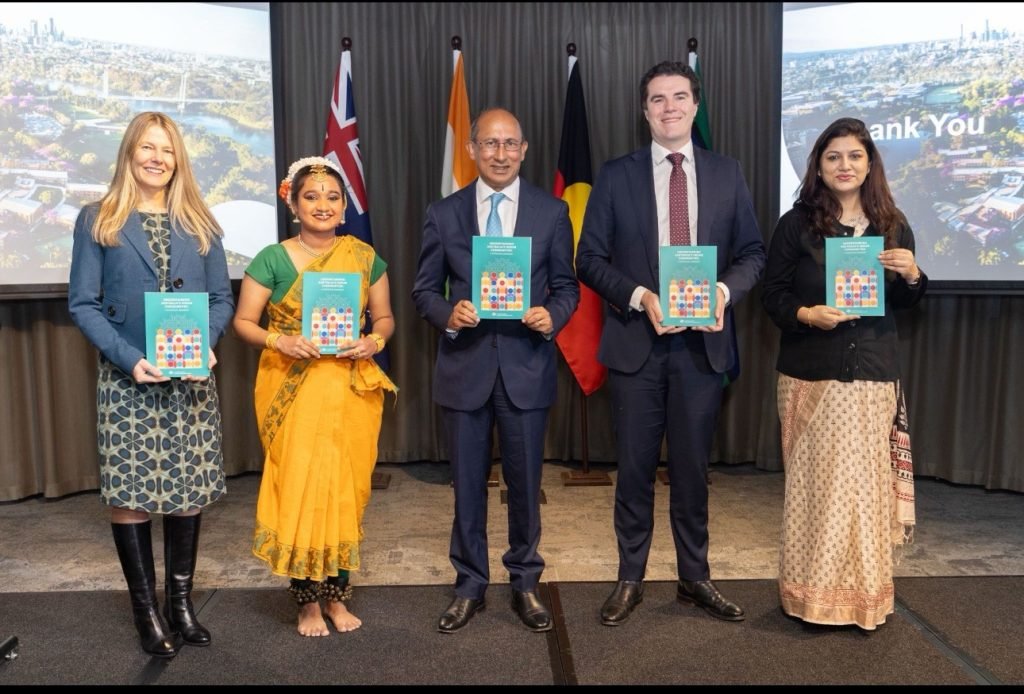
Below is an in-depth overview of the report, its key findings, voices at the launch, and why this matters—as told in a compassionate, accessible way.
1. Why This Report Matters
The new report is the most comprehensive statistical portrait of Indian Australians to date, drawing on data from 1987 to 2022. Compiled by a team from UQ, Deakin, and Griffith, on behalf of DFAT, it goes beyond stories and anecdotes, providing real numbers that help us understand generations, professions, languages, religions, and social impacts.
2. A Snapshot: Who We Are
Growth & Demographics
As of the 2021 Census, around 783,958 people in Australia identify as having Indian ancestry—about 3.1% of the population—and 721,050 were born in India. In 2024, Indian-born residents reportedly exceeded 1 million, making India the fastest‑growing source nation in Australia. Projections in 2022 estimated the Indian-born population could reach 1.07 million by 2035, up from over 721,000 in 2020.
Education & Workforce
Indian migrants are among the most highly educated groups: 54.6% hold a bachelor’s degree or higher, compared with ~17% across Australia. Many arrived as students—India was both Australia’s largest source of skilled migrants and second-largest source of international students around 2019–2020.
Economic & Civic Contribution
Indian Australians contribute significantly: approximately 88% are of working age, with 61% in full‑time work and 27% part‑time, making them the second‑highest tax‑paying migrant group after British-born Australians. Through business, science, academia, arts, civil society and sport, the community has had visible impact— including during extreme events like bushfires and the pandemic, offering resilience and civic leadership.
3. Voices from the Launch
The launch took place at Brisbane’s Customs House on 25 July 2025, and featured key figures shaping Australia–India ties:
Tim Watts MP, Special Envoy for Indian Ocean Affairs, reflected on the diaspora as “a powerful strand in the bond between the land of your home, and the land of your heritage.” He noted the community’s “sophisticated and pragmatic approach to electoral participation,” describing Indian Australians as a discerning electorate. Peter Varghese AO, Chancellor of UQ, spoke to the power of the diaspora in public diplomacy and called on diaspora leaders to help reframe India’s perception of Australia as a “modern, sophisticated, multicultural society.” Brett Lovegrove, UQ’s Pro Vice-Chancellor (Global Partnerships), highlighted how the report “moves beyond anecdote into insight” and helps celebrate and support “a vibrant, diverse and deeply influential community.” Neetu Bhagotia, Consul General (Brisbane), and Sarah Storey, DFAT First Assistant Secretary for South and Central Asia, also attended—reinforcing the diplomatic bonds and mutual interest.
4. What the Data Tells Us
Generational Trends
The report highlights multi‑generational Indian Australian families, including first‑generation arrivals, second‑ and third‑generation descendants—giving a nuanced view of identity, integration, and cultural retention over time.
Profession, Language & Religion
Indian Australians are over-represented in fields such as science, healthcare, education, engineering, and business leadership. Languages spoken at home among Indian Australians include Hindi, Punjabi, Tamil, Bengali, Malayalam, Gujarati and others—many ranking in Australia’s top ten community languages. Religious profiles show: ~45% Hindu, ~20% Sikh, ~10% Catholic, and ~6% Muslim—demonstrating diversity distinct from India’s religious mix.
5. Why It Matters to Australia
A National Asset
The DFAT‑commissioned report Australia’s Indian Diaspora: A National Asset (March 2022) frames the diaspora as a dynamic force that strengthens Australia’s ties with India—economically, diplomatically, and socially.
Indian Australians are steadily filling leadership roles in academia, business associations, and government. Their presence can boost trade, SME links, bilateral investment—and help Australian businesses navigate India’s complex markets.
Cultural Bridges & Public Diplomacy
Community networks such as the Federation of Indian Communities of Queensland (FICQ) (33 affiliated organisations as of March 2023) organise festivals like Diwali, support newcomers, and strengthen people-to-people ties.
Indian Australians were central in supporting community health, civic information, and outreach during national crises.
6. What This Means for Indians in Sydney
The report’s insights help Indians in Sydney better understand community demographics, needs, and potential. Stakeholders—from policymakers to educators to business leaders—can use these insights to design responsive programs, deliver culturally aware services, and harness the economic and social power of the Indian community. Indian Australians in leadership roles have opportunity to amplify these findings and frame the narrative of multicultural Australia.
7. Key Takeaways
Rapid growth: From ~721,000 Indian-born residents in 2020 to over 1 million by 2024. Highly educated and economically vital: Over half hold university degrees; strong workforce participation. Diverse representation: Across sectors from medicine and academia to arts and law. Civic and cultural engagement: Active in community-building, diplomacy, social resilience. Opportunity for engagement: With the right strategies, the diaspora can deepen Australia–India ties and enrich national policy.
8. Looking Ahead: What’s Next?
Download and Share the Report: The full report—Understanding Australia’s Indian Communities: A Statistical Snapshot—will be published online shortly. Watch detections by UQ and DFAT. Community Leadership: Indian Australians, including organizations like Indians in Sydney, can build on this data to advocate for inclusion in multicultural planning, education design, and policy initiatives. Diaspora Engagement Strategy: Australia’s future benefit lies in recognising Indian Australians as national assets—and supporting them to contribute meaningfully at all levels.
9. Final Thoughts
This report is more than numbers—it reflects real families, dreams, and shared futures. For children and elders alike, it affirms that Indian heritage and Australian citizenship can flourish together.
we must ensure that every statistic is matched with compassion, every dataset with dialogue. Only then can we create a multicultural Australia where each person’s story is acknowledged and valued.