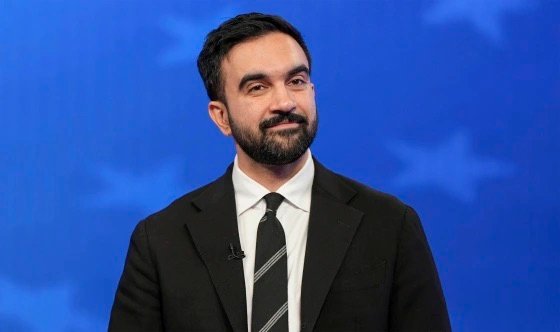
When the news broke that Zohran Mamdani had won the New York City mayoral election, social media erupted, newsrooms scrambled, and political observers across continents paused. It was not the kind of result anyone could simply scroll past. New York is no ordinary city. Its politics ripple across continents. Its leaders, for better or worse, shape global imagination.
But this victory felt different — not merely political, not merely symbolic.
It felt personal to millions.
Because in the 21st century, when democracy feels exhausted, when communities feel more divided than ever, when identity politics overshadows ideas, New York elected someone who defied every predictable narrative.
Mamdani, a Ugandan-born Indian of Gujarati Muslim heritage, did not win because of his surname, his skin, or the labels the world might attach to him.
He won because everyday New Yorkers – more than 50% of them – decided he earned their trust.
This is the world’s most diverse city choosing hope over fear, issues over noise, and substance over surface.
A Victory Shaped by Ideas, Not Identity
Global media, understandably, has been quick to frame this win through identity: the “first,” the “only,” the “historic.”
But what makes this result remarkable is what it is not.
It is not a victory born of a viral campaign.
It is not a “TikTok mayor.”
It is not the triumph of a demographic block.
It is the triumph of ideas.
Of community organising.
Of policy seriousness.
Of everyday people believing that change is not an Instagram filter – it is hard work and honest leadership.
In a world where political campaigns often resemble celebrity shows, Mamdani was – almost ironically – traditional:
Door-to-door conversations.
Town hall meetings.
Grassroots volunteers.
Community trust built one handshake at a time.
It felt like a throwback to the politics of substance — the kind that families discuss at dinner tables because it affects schools, safety, rent, transport, and dignity in real life.
Global Leaders React – With Celebration, Curiosity, and Caution
Within hours of the result, leaders from across the world reacted.
The tone varied, but the message was clear: the world was watching.
India’s political leadership expressed pride, noting that Mamdani’s journey reflected the power of global Indian communities contributing to democratic institutions across the world. Several leaders from the Opposition benches celebrated him as a symbol of progressive politics and diaspora excellence.
African leaders, especially from Uganda and Kenya, highlighted his transcontinental heritage as a reminder that human stories travel far beyond borders. They used his victory to speak about migrant resilience, identity, and opportunity.
Western commentators – from London to Toronto – framed the win as evidence that urban democracies are undergoing a generational shift. Young voters, renters, workers, and marginalised communities are demanding a new type of leadership: grounded, compassionate, fact-driven, human.
Of course, as with any major political shift, there was criticism too.
Some conservative figures questioned whether his policies would be too idealistic for a city with deep financial, safety, and infrastructure issues.
A few commentators, unfortunately, tried to reduce his win to identity politics – claiming New York voted “for diversity” rather than governance.
Yet the facts stand unshakably:
He won because a majority of New Yorkers – across race, class, and age – voted for him.
Democracy spoke louder than cynicism.
His Reference to Nehru: A Moment of Democratic Reverence
Perhaps the most striking part of Mamdani’s victory speech – beyond the emotion in his voice – was his reference to Jawaharlal Nehru.
In a world where political leaders often weaponise history, Mamdani chose to invoke Nehru not for nationalism, but for democratic philosophy. He quoted – or paraphrased – a sentiment Nehru expressed repeatedly: that democracy is a trust held between leaders and citizens, not a trophy handed to politicians.
Nehru believed that power must always remain tied to responsibility, humility, and listening.
Mamdani chose this moment to remind New Yorkers – and perhaps himself – that leadership is not about applause but accountability.
It was a rare instance where history did not feel like nostalgia.
It felt like guidance.
A New York Mayor Will Always Be Watched Closely – And He Knows It
One universal truth about NYC mayors:
Their honeymoon period lasts about one press conference.
New York applauds, yes.
But New York also scrutinises.
The world sees this city as a mirror of modern democracy – messy, chaotic, beautiful, restless.
Mamdani will have supporters cheering his boldness, critics questioning his ideology, and analysts dissecting his policies.
That is the price of leadership in a global city.
But what sets him apart is not his background – it is his awareness.
Throughout his campaign, he acknowledged that leadership means being listened to and being held accountable at the same time.
Not every politician has the humility to admit that.
A Beacon for the Young – Especially Those Who Feel “Different”
Across Sydney, Melbourne, London, Johannesburg, Toronto, Mumbai, Lahore, Kampala – young people watched this election closely. Not because they dream of being mayor, but because they dream of being seen.
For the child who speaks English outside and their mother tongue at home.
For the teenager balancing two cultures while feeling like they belong to neither.
For the migrant family that starts from zero in a new country.
For the young professional who feels underestimated because of their name, accent, or passport.
Mamdani’s win whispers something powerful:
You do not need to be born into privilege to lead.
You do not need the “right face” to be trusted.
You do not need to fit the stereotype to be taken seriously.
If your intentions are sincere, democracy has room for you.
In an age of division, this message feels almost revolutionary.
Why This Moment Hits Home for Us in Australia
We have seen thousands of stories of struggle, success, identity, and belonging. Our community understands the weight of being “the other” – yet also the power of building bridges, contributing, uplifting, and belonging.
Australia, like New York, is a mosaic of communities, dreams, and identities.
Mamdani’s win reminds us that diversity is not a challenge to democracy.
It is its lifeblood.
This is also a lesson for Australia’s young Indian-Australians:
Your story matters.
Your voice matters.
Your presence matters.
And yes – you can lead.
Beyond Symbolism: A Test for Modern Democracy
This moment is bigger than one election.
It is a reflection of a global shift that has been brewing silently:
Young voters demanding honesty. Migrant communities seeking fairness. Urban populations tired of old political patterns. Citizens wanting leaders who understand lived realities.
Mamdani represents a generation of public figures who do not fit into neatly curated boxes.
His identity is broad and layered – Indian by lineage, Ugandan by birth, New Yorker by soul, Muslim by faith, and human above all.
This complexity is not a burden.
It is a strength that allows him to connect with a wider world.
A Final Thought: The Return of Human Politics
In the end, what makes this moment profound is not the victory itself, but what it symbolises in a world fatigued by division.
It signals the return of human politics — politics that listens, that empathises, that acknowledges complexity instead of simplifying people into categories.
A politics that believes leadership is not about looking powerful, but about lifting others.
We do not know how Mamdani’s tenure will unfold.
We do not know whether he will solve all the crises New York faces.
No leader can.
But today, his win stands as a reminder that:
Democracy may bend, but it has not broken.
Diversity may be challenged, but it remains powerful.
And hope — when carried by millions — can still move mountains.
For now, that is enough to celebrate.