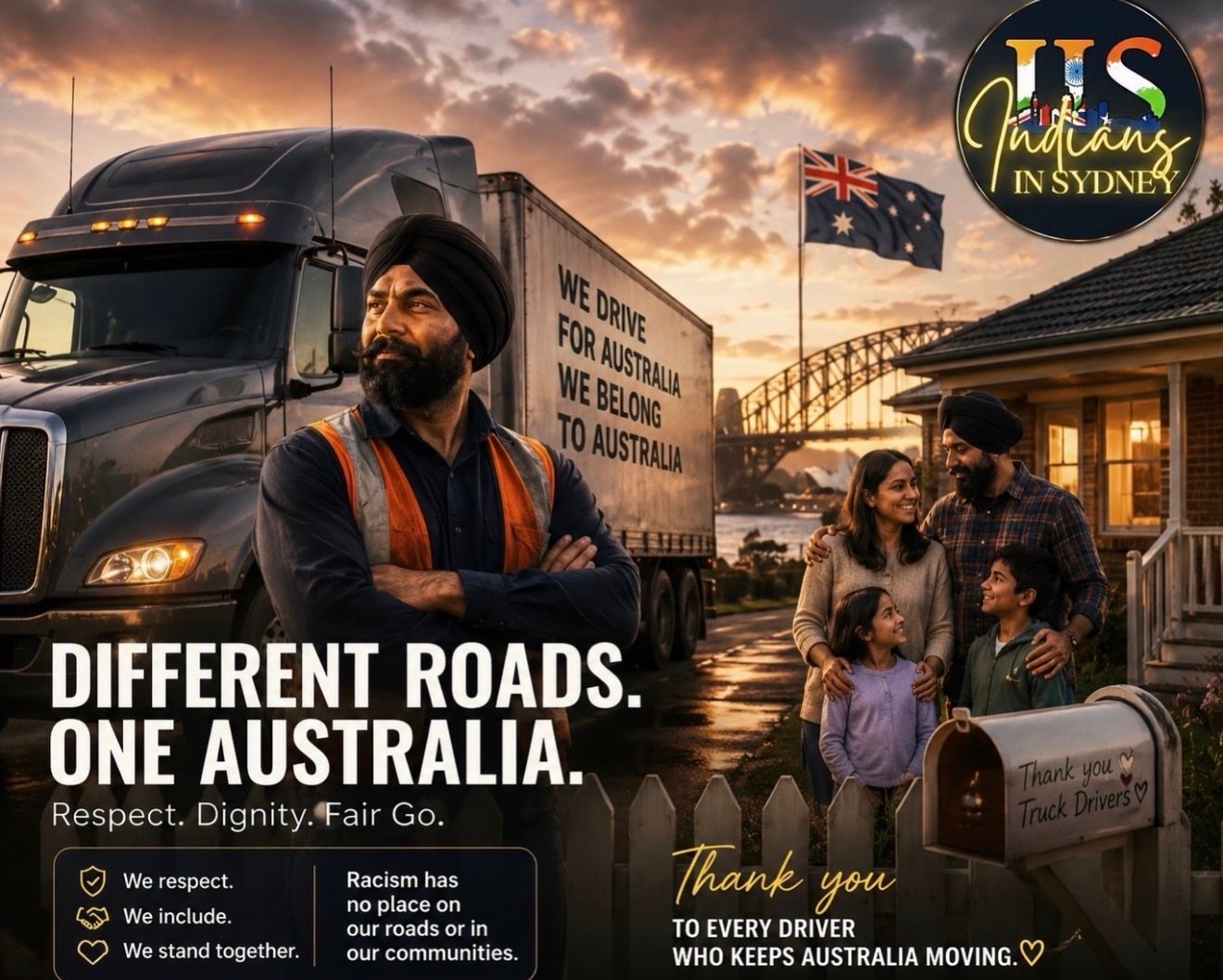
There are some words that stop you in your tracks.
“A good Indian is a dead Indian.”
Behind those words is not just a sentence. It is a reminder that racism is not an abstract debate. For the person hearing it, it can become a moment of fear, humiliation and disbelief.
A person who leaves home every day, climbs into a truck, delivers essential goods and helps keep Australia moving should never have to question whether their identity makes them a target.
Recent reporting by ABC News has brought attention to allegations from Indian-origin truck drivers who say they have experienced repeated racial abuse while working on Australian roads. The reports include claims of abuse through UHF radio communication and an allegation from a driver who said he was spat on at a South Australian truck stop while speaking Punjabi on the phone with his wife.
These are serious allegations. They deserve to be investigated, understood and addressed.
But they also require something equally important: perspective.
The actions of individuals who engage in racism do not represent Australia’s trucking community. They do not represent Australian values. They do not represent the millions of people across this country who believe respect and fairness are fundamental.
The human stories behind the headlines
ABC News spoke with several Indian-origin drivers who described their experiences of discrimination.
Jaswinder Boparai, an Australian citizen and truck operator, told ABC News about an alleged incident where he was spat on at a truck stop after speaking Punjabi on the phone. He described the experience as humiliating and something he would never forget.
Another driver, Pippal Singh, told ABC News that he had heard racist abuse and threats through truck radio communication and said the experience had made him reluctant to use the radio system.
These accounts highlight a difficult reality: racism is not always visible. Sometimes it happens in workplaces, online spaces, transport networks or everyday interactions where people feel they can escape accountability.
Racism affects more than the person targeted
Racism is not only about offensive words.
Experts say discrimination can affect mental wellbeing, workplace confidence, safety and a person’s sense of belonging.
Professor Sarah Anderson from Monash University told ABC News that adding racism and aggression to an already stressful profession like truck driving can affect drivers’ ability to perform their work safely.
The Australian Human Rights Commission has also highlighted that racial discrimination remains a significant issue in Australia. Its reporting notes that people continue to experience discrimination based on skin colour, ethnic background, religion or country of origin.
Australia is a nation built through migration.
More than half of Australians were born overseas or have at least one parent born overseas, according to Australian Human Rights Commission data.
Our diversity is not a weakness.
It is one of our greatest strengths.
The contribution of migrant workers
Every day, thousands of migrant workers contribute to Australia’s economy and communities.
Truck drivers from many backgrounds including Indian, Australian-born, Chinese, Filipino, African, New Zealand and many others help transport food, medical supplies, construction materials and essential goods across the country.
The freight industry depends on people who often work long hours, spend time away from their families and carry enormous responsibility.
A person’s accent, language, religion or cultural background does not reduce the value of their contribution.
We must reject collective blame
One of the greatest dangers in conversations about racism is allowing the actions of a few people to define millions.
Just as racism against Indian Australians is unacceptable, it is also wrong to judge an entire community because of the actions of individuals.
Social cohesion requires fairness.
It requires us to say:
A racist act is wrong.
A racist comment is wrong.
A person should be judged by their behaviour, not their background.
What does Australia’s future look like?
The Australia many migrants dreamed of was not a country without differences.
It was a country where differences could exist with respect.
A country where someone could speak Punjabi, Hindi, Mandarin, Arabic, Greek or any other language without fear.
A country where someone wearing a turban, hijab, cross, cultural clothing or traditional dress belongs equally.
A country where our children grow up understanding that diversity is not something to tolerate it is something to value.
The responsibility belongs to all of us
Governments have a role.
Employers have a role.
Industry leaders have a role.
Communities have a role.
But ordinary people also have a role.
When we hear racism, we should not ignore it.
When someone experiences discrimination, we should support them.
When conversations become about blaming communities, we should bring them back to facts and humanity.
Because racism against one group damages the trust of every group.
Whether the victim is Indian.
Whether the victim is Indigenous.
Whether the victim is Jewish.
Whether the victim is Muslim.
Whether the victim is Chinese.
Whether the victim is African.
Whether the victim is Australian-born.
Human dignity has no nationality.
At Indians in Sydney, we believe Australia’s multicultural success story must be protected by all of us.
Not through anger.
Not through division.
But through courage, compassion and a commitment to respect.
Because the Australia worth building is one where every person can say:
“I belong here.”
Sources and verification notes:
- ABC News investigation into allegations of racism targeting Indian-origin truck drivers and workplace impacts.
- ABC PM program interview coverage with drivers and workplace expert commentary.
- Australian Human Rights Commission information on racism, discrimination and social cohesion.