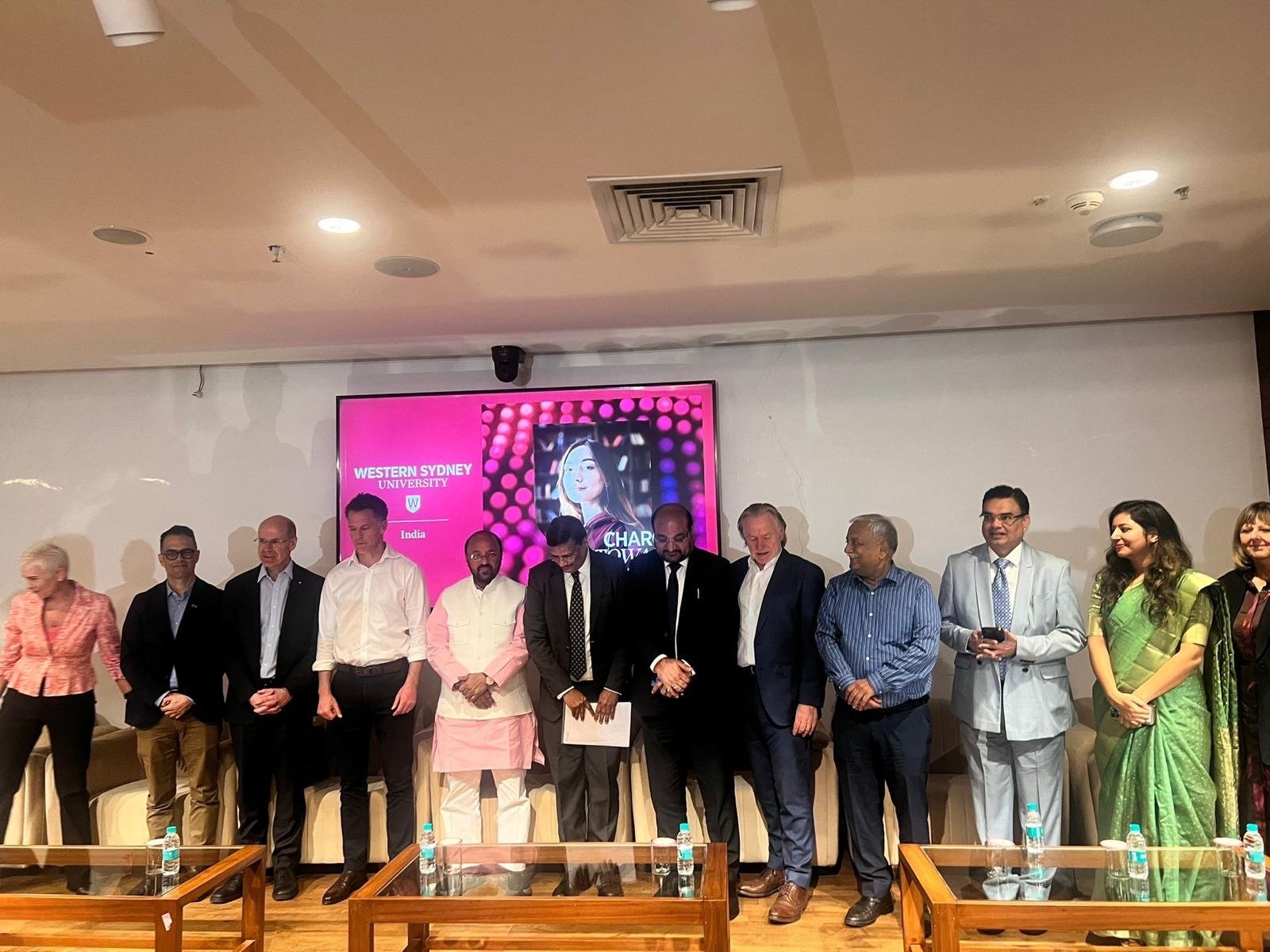
Four days. Two cities. One very large question: what does India mean to the future of New South Wales?
It would be easy to judge Chris Minns’ first official visit to India by the usual measures.
How many meetings? How many announcements?How many dollars? How many agreements? But that would miss what was perhaps most interesting about the journey.
Because somewhere between a Delhi community centre, a cricket game, a university campus, a temple, a gurdwara, an airline meeting, a Mumbai memorial, a dabbawala station, Haji Ali and a room full of India’s corporate leaders, something larger was taking shape.
This was a trade mission, certainly.
But it was also a lesson in how modern diplomacy is changing.
And for NSW, it was a reminder that the India relationship is no longer happening somewhere “over there”.
It is already here.
Delhi: start with the people
The journey began on 31 August. And premier did something that set the tone.
He went into Mayapuri with Asha, an organisation working with communities experiencing poverty across Delhi.
He walked through the neighbourhood. He visited a local home. He met children, families and elderly people benefiting from Asha’s health, education and community programs.
Then came cricket. Gully cricket.

For a few minutes, the NSW Premier was not standing behind a lectern talking about trade.
He was holding a bat while children gathered around him.
It was perhaps the most natural image of the entire trip.
The significance was not the cricket itself. It was the decision to begin by seeing a part of Delhi that a conventional business delegation could easily have passed by.
One of the young people he met was Madhu, who grew up in a South Delhi slum and is preparing to come to Sydney to study a Master of Public Health at the University of Sydney on a scholarship.
Her journey says more about Australia–India relations than any spreadsheet can.
A young woman from Delhi preparing to build her future in Sydney.
That is what an international relationship looks like when it becomes human. (ABC News)
From Mayapuri to the future. The next stop was almost the opposite world.
The delegation travelled to Greater Noida for the Western Sydney University India campus.
Here the language changed from opportunity for one student to opportunity for thousands.
The campus is expected to welcome its first students in 2027, strengthening educational links between India and Western Sydney.
There is something particularly significant about that location.
Western Sydney is one of Australia’s great multicultural regions. Greater Noida sits in one of India’s great population centres.
The two places are now connected not simply by flights, family and migration, but by an institution of learning.
That is long-term diplomacy. Governments change. Ministers change.
But a student who studies in India through an Australian institution, or an Indian student who comes to Sydney, becomes part of the relationship for decades.
Then came faith
The journey moved from classrooms to places of worship.
Premier and Treasurer Daniel Mookhey visited Swaminarayan Akshardham Temple and Gurudwara Bangla Sahib.
At Bangla Sahib, they met volunteers preparing thousands of free meals for people in need.

At Akshardham, they encountered one of India’s most recognisable expressions of Hindu architecture, spirituality and heritage.
These were not trade meetings.
There was no investment figure attached.
And that is precisely why they mattered.
For a NSW Premier, visiting India’s religious and cultural institutions is also a way of understanding the people who have made NSW their home.
Sikh Australians. Hindu Australians. Muslim Australians.
Indian Australians of many traditions and backgrounds. This is where the phrase cultural diplomacy stops being a diplomatic cliché.
It becomes real.
You cannot build a deep relationship with India while understanding only India’s economy.
You have to understand its people.
The harder sell: business
Of course, this was not a cultural holiday.
Minns and Mookhey were there to sell NSW. And India is a market NSW cannot afford to ignore.
Two-way merchandise trade between NSW and India was worth $6.87 billion in 2024–25.
More than 28,000 Indian students studied in NSW in 2025. In the year to March 2026, 174,000 Indian visitors travelled to NSW, spending around $600 million.
The numbers are already significant. The argument from the NSW Government is that they could be much bigger. (NSW Government)
The delegation met major Indian resource companies including NMDC, NTPC Mining, Hindustan Copper and Coal India, looking at critical minerals and the possibility of Indian investment in NSW.
There were conversations around technology, advanced manufacturing, clean energy and tourism.
And then there was aviation.
Minns met Air India representatives to make the case for an Indian airline to serve Western Sydney International Airport.
There was no formal agreement.
That detail matters.
It would be easy to write “NSW is getting direct India flights”.
It isn’t – at least not yet.
The Premier himself acknowledged the discussions were ongoing and that financial incentives were being considered.
That is the difference between a political announcement and an actual outcome.
The pitch has been made.
Now NSW has to win the deal. (ABC News)
Mumbai: from opportunity to memory
Then the journey moved to Mumbai. And before the business meetings came remembrance.
At the Taj Mahal Palace, Premier, Mookhey and Mrs Anna Minns laid wreaths at the memorial for victims of the 2008 Mumbai terrorist attacks.
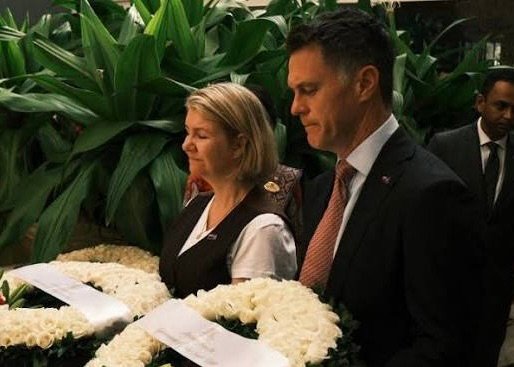
Two Australians from NSW were among those killed. The attacks claimed 166 lives across Mumbai. Thirty-one people died at the Taj itself. The delegation signed the memorial book.
There was no business announcement here. Only remembrance.
It was an important moment because mature international relationships are not built only around what we want from each other.
They are also built around what we remember together. (Sydney Times)
The Mumbai that doesn’t sit in a boardroom Then came the dabbawalas.
If Mumbai has a thousand stories, the dabbawala may be one of its most extraordinary.
For more than a century, the city’s lunchbox delivery workers have built a remarkably disciplined system for moving home-cooked meals across one of the world’s most complex cities.
Minns met them and heard about a system that delivers more than 200,000 tiffin boxes a day without relying on the kind of technology many modern businesses consider indispensable.
It was another reminder that innovation does not always come with an app.
Sometimes it comes from people, discipline, trust and knowing your city. (Mid-Day)
Haji Ali And then there was Haji Ali.
Standing on an islet off Mumbai’s Worli coast, Haji Ali Dargah is a historic mosque and shrine associated with Pir Haji Ali Shah Bukhari and one of Mumbai’s most recognisable landmarks.
The Dargah Trust describes it as a place visited by people of different religions. The Mumbai City administration lists it among the city’s important religious landmarks. (Haji Ali Dargah)
For an Australian Premier, a visit to Haji Ali is not a trade negotiation. But that is exactly why it belongs in the story. Because if the India–NSW relationship is going to become deeper, it cannot exist entirely inside ministries, corporations and conference rooms.
It has to include culture. Faith. History. Food. Sport. And people.
Minns’ visits to Akshardham, Bangla Sahib and Haji Ali created a remarkable cultural arc across different faith traditions.
Not as a political statement about religion.
But as an acknowledgement of the extraordinary diversity that makes India what it is and the diversity that increasingly defines NSW.
The India that NSW wants
In Mumbai, Minns met Maharashtra Chief Minister Devendra Fadnavis.
The two signed a renewed NSW–Maharashtra sister-state agreement covering areas including clean energy, advanced manufacturing, technology, critical minerals, mining expertise, education and skills.
This is significant.
Maharashtra is not simply another Indian state.
Mumbai is India’s financial capital and Maharashtra is one of its major economic engines.
The relationship between Maharashtra and NSW has existed for more than a decade.
The renewal gives it another chance to become more than ceremony. And that is the question that should follow the Premier home.
Can these agreements produce something tangible?
More investment?
More jobs?
More students?
More research?
More flights?
More NSW companies selling into India?
That is where the scoreboard will eventually sit.
Diplomacy through stories
Perhaps one of the most intriguing announcements was not about minerals or finance. It was about stories. The Jaipur Literature Festival is coming to Powerhouse Parramatta in 2027.
And a new Australia–India film, The Indian Cowboy, will tell the story inspired by musician Bobby Cash – a man whose journey took him from Dehradun to Australia’s country music capital, Tamworth.
Think about that for a moment. An Indian musician finds an audience in Australia. An Australian city becomes part of his story. Now that story is coming back to India through cinema.
That is cultural diplomacy with a pulse. It doesn’t ask people to read a memorandum. It gives them a story they can feel.
The politics cannot be ignored There is, inevitably, a political dimension. Premier chose India for his first overseas trip as Premier.
That is a statement.
He has also repeatedly pointed to the more than 200,000 Indian-born people living in NSW as an enormous advantage for the state’s relationship with India.
And he is right about one thing: diaspora communities can be extraordinary bridges between countries.
But governments should be careful.
Indian-Australians should not be seen simply as a “bridge” to an overseas market or as an electoral constituency. They are Australians.
Their contribution to NSW exists independently of what they can do for trade.
The strongest version of multiculturalism is not: How can migrants help Australia connect with their country of origin?
It is: How do we recognise that people with different histories are already part of the Australian story?
That distinction matters. So, was it a successful visit?
It is too early to give the trip a final score.
The Premier returned with real developments: progress on the Western Sydney University campus, a renewed Maharashtra partnership, new technology and investment discussions, creative-industry opportunities, food and beverage market access, and continuing conversations about aviation.
Those are meaningful. But an announcement is not an outcome. A memorandum is not an investment.A meeting is not a job. And a promise of a future flight is not a flight.
The real test will come months and years from now.
If Indian capital flows into NSW, if NSW businesses expand into India, if students move between our universities, if new flights connect Western Sydney with India, and if the partnerships signed in Mumbai produce measurable results then this journey will have mattered.
The journey home
Perhaps that is why the strongest image from this trip wasn’t a handshake between politicians.
It was a child playing cricket in a Delhi lane.
A young woman preparing for Sydney.
Volunteers serving food at Bangla Sahib.
The quiet of a memorial at the Taj.
Dabbawalas carrying their tiffins.
The white silhouette of Haji Ali against Mumbai’s sea.
And, eventually, two governments sitting down to talk about the future.
India and NSW are no longer distant partners.
They are increasingly connected by people who live between both worlds.
That is the real story of this journey.
The Premier went to India looking for investment, trade, students, tourists, technology and opportunity.
He found those things. But he also encountered something that cannot be measured in dollars.
A relationship built through people. And perhaps that is the most important lesson for multicultural Australia.
“We don’t just carry our heritage with us. We carry it forward.”
The photographs from India are now over.
The agreements have been signed.
The cricket bat has been put away.
The real journey starts now.
This is the version I’d publish. It has warmth without becoming a puff piece, scrutiny without becoming hostile, and most importantly the Indian-Australian community is treated as part of Australia’s story, not merely as a diplomatic instrument.